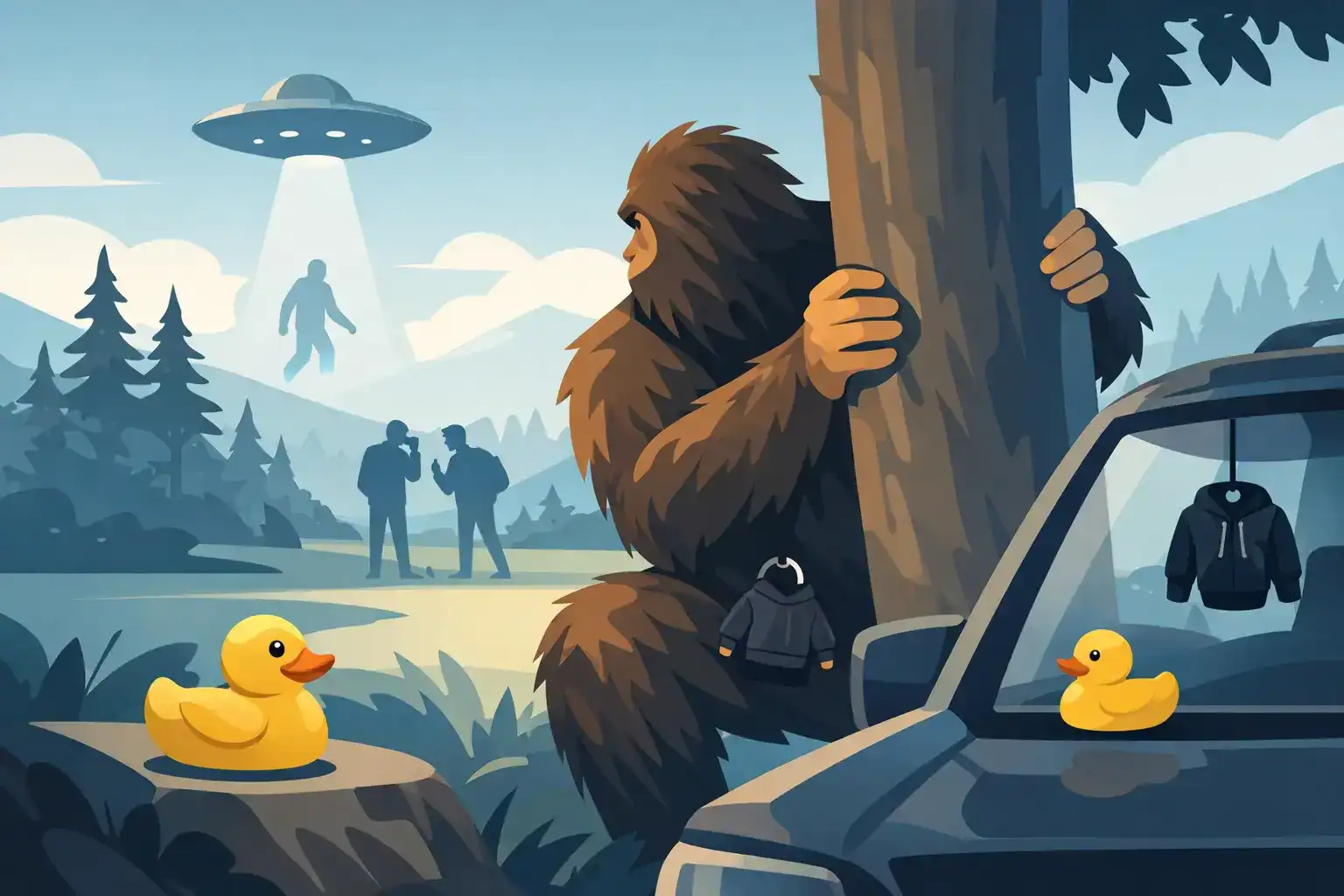
Sasquatch Ducking: Joke, Trend, or Signal?
You hear a phrase like sasquatch ducking once around a campfire and it should be easy to forget. Somehow it never is. It sticks because it sounds half ridiculous and half believable – exactly the kind of saying outdoor folks keep alive for years, whether they mean it as a joke, a warning, or a quiet nod to the old story that maybe something big is still moving through the timber.
What sasquatch ducking really means
Most of the time, sasquatch ducking is less about a formal definition and more about a shared image. Picture a massive shape slipping behind brush, crouching low behind a deadfall, or dropping out of sight just long enough to make you question what you saw. That moment – the sudden dip, the quick hide, the almost-seen movement – is the heart of the phrase.
In plain terms, sasquatch ducking describes the idea of Bigfoot avoiding detection on purpose. Not running full speed. Not charging. Just keeping low, keeping hidden, and using cover better than most people expect from something so large. That simple picture is why the phrase has legs. It turns a blurry mystery into a scene you can almost watch in your head.
Why sasquatch ducking feels believable
People who spend real time outdoors know one thing city folks often miss – big animals disappear fast. A full-grown deer can vanish in brush that looks way too thin to hide it. A turkey can freeze so still it may as well be part of the woods. A black bear can move through cover with less sound than a man wearing sneakers in his own hallway.
That is why sasquatch ducking lands differently with hunters, campers, and folks raised around timber. The idea is strange, sure, but the behavior itself is not. If there were a large, wary creature out there, staying low and using terrain would be the smart play.
That does not prove anything. It just explains why the phrase survives. It fits what experienced outdoorsmen already know about how animals move when they do not want to be found.
The woods play tricks, but not always
There is always a trade-off in these stories. Sometimes a shape in the brush is exactly what your eyes first told you. Other times it is a stump, a shadow, or a hunter bent at the waist crossing a game trail. Low light, fatigue, distance, and adrenaline can turn a normal sighting into something bigger than life.
Still, anybody who has spent enough dawns in a stand or enough evenings on a logging road knows there are moments you cannot explain cleanly. Not every strange movement becomes evidence. Not every strange movement should be brushed off either. That gray area is where phrases like sasquatch ducking keep breathing.
Sasquatch ducking as outdoor folklore
American outdoor culture has always made room for stories that sit somewhere between humor and belief. We tell them at deer camp, on fishing trips, in garages, and beside fire rings after the coffee gets strong or the night gets long. These stories are not always trying to win an argument. A lot of the time, they are about belonging.
Sasquatch ducking works because it gives people a shared language for that kind of moment. You catch movement in the tree line, your buddy misses it, and now you have a phrase for the story on the drive home. It is funnier than saying, “I think I saw a large unknown primate crouching behind alder.” It is also more human.
That matters. Outdoor culture is built on stories passed person to person. Not polished. Not overexplained. Just good enough to make everyone lean in a little.
Why the phrase has staying power
Some sayings last because they are useful. Others last because they sound good. Sasquatch ducking does both. It is visual. It is a little absurd. And it taps into something Americans have always loved – the idea that the wild still holds a few secrets.
For people who value hunting, camping, back roads, and time with family outdoors, that idea is not childish. It is part of the draw. The country still feels like a country when there are places dark enough, deep enough, and rough enough that not everything in them has a label.
The internet changed the story
Before social media, a phrase like sasquatch ducking probably stayed local. It lived in small circles, maybe bounced from one county to another, and picked up new meaning along the way. Now one funny caption, one grainy clip, or one roadside photo can spread it across the country by supper.
That has helped and hurt at the same time. On one hand, the phrase now reaches people who already love outdoor humor, cryptid culture, and offbeat Americana. On the other hand, the internet rewards exaggeration. Every bent branch becomes proof. Every shadow gets called a sighting. That can flatten the good part of the story.
The good part is the tension. Maybe it was nothing. Maybe it was not. Sasquatch ducking works best when it leaves room for both.
Why outdoor people connect with sasquatch ducking
There is a reason this kind of phrase lands with folks who live close to the land. It respects the idea that nature is bigger than us. Not in a polished, tourist-brochure way. In the old-fashioned way. The way you feel when you hear something heavy in the dark and realize your flashlight does not make you the boss of the woods.
It also fits a certain kind of humor. Rural humor is often dry, understated, and just serious enough to keep you guessing. If a man says he saw sasquatch ducking behind a cedar swamp, he might be messing with you. He might also be telling the truth as he understands it. Either way, the story earns its place if it gets told well.
That blend of grit, mystery, and laughter is part of what makes outdoor identity feel real. It is not manufactured. It is carried in the stories people keep.
Is sasquatch ducking meant to be believed?
That depends on who is saying it.
For some, sasquatch ducking is a straight-faced explanation for why evidence always seems partial – a shoulder, a silhouette, a quick movement, then nothing. For others, it is pure campfire fun, a way to turn a weird noise in the brush into a running joke. For plenty of people, it sits right in the middle.
And honestly, that middle ground is where the phrase is strongest. Once you force it into either total belief or total mockery, it loses some of its charm. Outdoor traditions are full of things that do not need courtroom proof to matter. They matter because they bring people together, sharpen attention, and remind us that wonder still has a place in ordinary life.
Sasquatch ducking and the gear people wear
There is also a reason phrases like this show up on shirts, hoodies, stickers, and camp gear. They say something about the person wearing them without needing a speech. You do not have to claim you have seen Bigfoot to appreciate what the phrase represents.
It can signal that you love the outdoors, that you appreciate backwoods humor, and that you would rather spend a night by a fire than under fluorescent lights. It can also hint at something deeper – that you are still the kind of person who believes the country is worth protecting, family stories matter, and not everything needs to be ironed flat and explained away.
That is why identity-driven outdoor apparel works when it is done right. It is not just fabric. It is a flag for what kind of life you stand for. Brands like HoodyTee understand that better than most because the best outdoor gear says something before you ever say a word.
What sasquatch ducking says about us
At its core, sasquatch ducking is not really about proving Bigfoot exists. It is about keeping a certain American spirit alive – one that still leaves room for mystery, laughter, and stories told face to face. In a culture that likes to pin everything down, that matters more than people admit.
We need a few phrases that are rough around the edges. A few stories that are better around a fire than on a fact sheet. A few reminders that the woods are still the woods, and that some part of us feels more at home when the world is not fully explained.
So if somebody at camp says they saw sasquatch ducking at the edge of the clearing, you do not have to laugh them out of the chair or swear an oath to believe them. Just pour the coffee, listen close, and enjoy the kind of story that makes the outdoors feel wild again.